It was on a warm and pleasant summer's day that 6 members had a visit to the Forge Mill Needle Museum. Our main purpose was to view the exhibition 'Quilting Yarns' which comprised some of the quilts owned by Jane Cobbett, ranging from the 1860s to the 1950s. Here we are in front of the museum. Left to right there is Lynda, Alison, Paula, Ruth, Eileen and Ginnie.

The exhibition was very good, and while it wasn't huge (about 20 pieces altogether) it was lovely to have the time to view and discuss them all in detail, with like-minded enthusiasts. Here are photos of some of the quilts.
This one was entitled 'Woollen Comforter' and was made of feedsacks, recycled clothing and dressmaking scraps from the 1920s and 30s. It was made in Pittsford, New York, USA, and was particularly delightful in the motifs embroidered on many of the patches. Some were initials (including, strangely, Ruth's initials of A.R.W) mostly ending with S, some dated and having ages added - one as young as 3 months, so perhaps not done in person! Some were animals, rabbits, chickens, geese etc., and some little scenes, such as a beehive and returning from milking and other motifs including several hands and a guitar. There were some interesting stitches joining the patches together too, mainly feather stitch but with some intriguing variations. The quilt had cotton wadding and a woollen backing, and six people who all wished they could take it home with them!

This is the Pease quilt. It belonged to the Pease family of Darlington UK but was not British, and had probably been brought over from the USA by them. It was made in the 1880s and the block is called The Star of Alabama. We really liked this quilt, but wondered why the maker had included the two very dark star fabrics in the top blocks. Maybe it was all she had, but we also wondered whether all the fabrics had had the same intensity originally, but the rest had faded. This is where we wished we had more knowledge of dyes and their effects on fabric!

This was a small unfinished fragment called Fussycut Stars. It was Scottish and had been made in the late Victorian era. It was all silk, and the fabrics had been meticulously cut and pieced to make beautiful patterns in the centres of the stars. Some of them (on the bottom right for example) looked as if they had been embroidered, but on closer inspection, it was the pattern of the fabric which had been used to full effect. It had probably been shut in a cupboard for years, as the colours were sumptuous.

Here is another quilt made of silks, velvets and other fabrics. This one is not of the same quality, but when you realise that it had been made by a 12 year old girl called Elizabeth Brown as a doll's quilt, you can appreciate it fully. It was made in Barrow upon Humber, UK in 1877. The unusual arrangement of blocks makes the design look rather like flying geese.

Here is another log cabin, his time in the straight furrows arrangement. This quilt had been made of feedsacks in Nebraska in the 1930s. It had been tied with blue wool, and the ties make a pleasing pattern over the surface. Unusually for an American quilt, it had not been bound, but the edges had been folded in and whipstitched.

This is a Welsh quilt, or at least, what was left of it! The date was not known, but it was made in Glamorgan. Both sides had been cut off for some reason, leaving it in a sorry state. Just imagine if that was your quilt, and someone had taken the scissors to it! It's just too awful to contemplate!
 This beautiful quilt is a Bow Tie design, made in 1880, with blocks finishing at 4". We spent some time examining this at close quarters, trying to work out if it had been made over papers or not. (We didn't decide!) But when we had moved on and looked at it from further away, we were able to appreciate the soft colouring.

This Redwork quilt was made in Nantucket Island in the 1940s, probably from a commercial kits or pattern. It charmed us, and intrigued us in equal measure. Most of the blocks were cute designs of Sunbonnet Sue-type figures, but in the centre of the quilt (the first complete row in the picture above the bar) there were the initals V and K. We wondered if these were the initials of the maker or recipient. then we spotted another initial, I, in the second row, second block. Why were these letters included? Were they significant, or were they ones supplied with the kit, or ones she felt like making? There were no answers but we loved the freshness of the quilt.

Once we had viewed the exhibition, we went downstairs to see the recreation of a Victorian needle factory. We were amazed to find it took 30 different proceedures to turn a piece of wire into a needle, and the most skilled part, that of pointing the needle earned its workers a guinea (£1 and one shilling) a week, but gave them silicosis of the lungs, meaning that their life expectancy was only 30 years! Some young people had come to show the workings of the factory and were kind enough to let me take their photos. These young men were doing the shaping and stamping of the needles,
 these young ladies were filing the edges of the eyes, and the overseer was keeping a stern eye on them! All in all we had a great day out. The museum is well worth a visit, and there was a lovely picnic space with tables and a children's play area with plenty of space to play and run about. The exhibition runs only till the 28th June, so if you would like to see these quilts (and others) in person, then go quickly or you'll miss your chance. If you can't go but would like to see more of the quilts, look on my blog here for the rest of the photos.

 Here she is after her talk, giving Chris some advice about using dyes for her forthcoming art foundation course. All the different substances Linda has used, from the ubiquitous onion skins to osage orange bark, have been carefully documented and the results mounted on beautiful boards to display the effect on different fabrics.
 I thought that using non-commercial dyes required lots of equipment and chemicals, but apparently you just need a large pan, a spoon or stick, water, alum and then plant material. Good results can be obtained from onion skins and marigold flowers and for those wanting to really go back to basics, she had some packs of woad seeds on sale.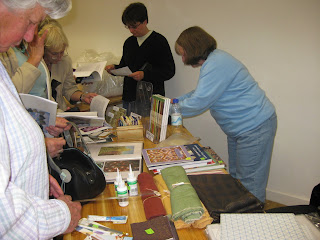


 Chris, Beverley, Sylvia and some friends have been making quilts for injured servicemen. This one so simple, but striking.
 Here is another one - a kind of grown up I-Spy, with novelty fabrics!
 Ruth had used some recycled fabrics (shirts and pyjamas) to make this quilt for the charity. It looks very sophisticated.
 I also finished a quilt from my UFO box. I made some Elly Sienkevicz Baltimore blocks a few years ago, and have finally layered and quilted them. I quilted feathers all round the borders - all good fun!
 Doreen showed this Sudoku quilt made from squares of fabric. Very effective.


 Bags and cushions can also be brought at the same time, as can the items for the sales table. Make sure your sales items are clearly labelled with a removeable label (can be sticky or pinned) giving your name and the price of the item. 10% of that price will be retained by the group. If you are willing to donate all the proceeds to the group, just write 'DON' on the label instead.

 Then a short stroll along country lanes to The Manor, former home of famous author, gardener and patchworker Lucy Boston. The house is the oldest continuously inhabited house in the country, the old part dating from the 1100s and the new part from the 1600s. Here are a group of members in front of the house waiting to begin the tour.

 While everyone enjoyed the garden, it was the patchworks which really interested us. We were not to be disappointed. Diana, Lucy's daughter-in-law, told us that when Lucy had first moved to The Manor with her husband, she had bought a couple of hexagon patchwork quilts which were the perfect size for blocking draughts from the lounge windows. One of the quilts had a label saying 'started in 1801, finished in 1803' and due to their age, the draughts and smoke from the fire, the quilts eventually started to wear. Lucy repaired the quilts and this started her interest in making patchworks of her own. Unfortunately Diana did not want me to take photos of the quilts,
  picture of her most famous design, The Patchwork of the Crosses. The block is completely made over papers, and consists of lozenges and squares (some on point). Due to Lucy's clever use of value and pattern, no two blocks look alike, and several are almost unrecognisable as being the same design. If you would like to look at some interpretations of this block, look
  This quilt was made for The Astronomer Royal, and used lots of celestial motifs. If you would like to find out more about Lucy Boston and Hemmingford Grey, I can recommend a visit, or if all else fails, look at Celia Eddy's wonderful article
  While we enjoyed the house, the gardens and surroundings, it was again the patchwork (this time an exhibition) which had drawn us. No photographs allowed again but we enjoyed looking at others' work, although some pieces were a bit arty for our tastes, and some of the prices were a bit mind boggling! Still, we decided that it was the time which had gone into the pieces (mainly wall-hangings) which was important.
 A new idea this year will be a bag and cushion raffle. We are asking members to make either a bag or cushion (or hopefully both!) for the raffle. Each item will be displayed, and people will be able to buy a ticket for the bag or cushion of their choice. Each set of tickets will be placed in a separate container for the cushions and in the bag itself for the bags. At the end of the day, a ticket will be drawn from each container, thus ensuring that every winner will be thrilled to get the item they most wanted! What a clever idea! This means that you won't see the item you've made donated to another raffle next week!
 There was much excitement when Ruth unveiled the finished group quilt. Everyone was amazed at how good it looked, as several people secretly confided to me that they had been a bit skeptical when the background and balloon blocks had been first displayed! Apart from the fact the 27 people had taken part, the assembling had been done by Ruth, Lynda, Di and Paula. Many thanks to them for all their hard work. (And also thanks to my talented daughter, who gave us design inspiration when we were all stuck!)


 Chris brought several quilts for us to see.
 I had looked through the donated Linus fabric, and found a lot of dark plaids, which have been put together beautifully in this quilt. Keep up the good work, ladies!
 Stephanie had made some cushion covers which were all made from strips of fabric sewn into squares, then chopped and mixed up. This ensured that they all match, as they are all made from the parts.
  Stephanie and Sharon had finished their hand quilting which they had started on the Sandie Lush workshop. Beautiful work.
 Last year, Flutterwheels's theme was stars. These were choppy stars, which Chris won. She fell in love with the fresh colours and quirky look of these blocks and has made them into a quilt for herself. Perfect colours for a dreary day, I would say.
  Nearly every meeting sees Paula presenting me with a quilt for Project Linus! This one is dancing gingerbread men (or star jumping gingerbread men as I prefer to call it!) Many thanks Paula. You're a star!
